

For retail buyers, interior designers, and product developers entering the overseas manufacturing landscape, the quotation sheet is often an intoxicating document. You find an overseas manufacturing partner in Vietnam or China, spec out a line of woven rattan accent chairs, handcrafted ceramic table lamps, or solid wood sideboards, and receive an initial quotation: $42.00 FOB.
Back home, you plan to retail the item for $240.00, or wholesale it for $120.00. On paper, the gross margin looks bulletproof. The product development team celebrates, financial projections are populated with healthy multipliers, and the purchase order is issued. – Then reality strikes.

Sourcing Overseas: The Real Costs Beyond the FOB Price
Six to nine months later, after the container clears customs, navigates regional drayage, is unpacked at your 3PL or distribution warehouse, and finally reaches customer living rooms, your accounting team runs the post-mortem. The actual landed cost wasn’t $42.00. Once all expenses settled, the real cost per unit landed closer to $84.50. Margins eroded, profitability vanished, and what appeared to be an exceptional sourcing win became an operational headache.
What went wrong? You evaluated the project solely on the FOB (Free On Board) price.
At Mondoro, after decades of developing, engineering, and manufacturing home décor, furniture, and lighting alongside vetted partner factories in Vietnam and China, we have seen this scenario unfold repeatedly. Sourcing overseas remains one of the most powerful strategies to scale margins, access world-class craftsmanship, and build proprietary product lines. However, sustainable profitability requires calculating the Total Landed Cost (TLC) before issuing a single deposit.
To protect your balance sheet and avoid margin shock, here is an executive breakdown of the hidden, variable, and operational expenses that lie beneath the surface of an overseas FOB quote—and how transparent manufacturing planning prevents costly surprises.
1. Deconstructing the Illusion of the FOB Price and Sourcing Overseas
In international commercial terms (Incoterms), FOB (Free On Board) means the seller is responsible for the costs and risks of the goods up until the point they are loaded onto the shipping vessel at the designated port of origin (e.g., FOB Ho Chi Minh City, FOB Shanghai, or FOB Shenzhen). The factory pays to manufacture the goods, handles local inland transport to the port, and covers export customs clearance documentation.
The moment the cargo crosses the ship’s rail, the financial risk and operational costs transfer entirely to you, the buyer.
FOB is a baseline production metric; it is not your landed product cost. Assuming that FOB plus a nominal ocean freight buffer equals your final unit cost ignores the volatile realities of global logistics, tooling amortizations, quality assurance contingencies, packaging engineering, compliance testing, and inventory holding costs.

Let’s unpack each component to see how costs compound.
2. Tooling, Molds, and Sample Amortization: The Upfront Capital Drain and Sourcing Overseas
Before a single container rolls off an assembly line, substantial capital is committed during the prototyping and tooling phase. Many procurement teams categorize tooling as a one-time sunk capital expenditure (CapEx) rather than amortizing it across initial production runs, artificially deflating their perceived unit cost.
Custom Tooling and Molds
If your home décor or lighting collection requires bespoke hardware, unique metal stamped canopies, spun brass bases, die-cast components, or rotomolded ceramics, you will incur tooling and mold fees.
- A custom metal extrusion die or aluminum casting mold can range from $1,500 to $8,000+, depending on complexity and lifespan.
- If your initial Minimum Order Quantity (MOQ) for that collection is 500 units, a $4,000 mold fee adds $8.00 per unit directly to your baseline cost.
Iterative Prototyping and International Courier Costs
Developing a product from an initial tech pack to a golden master sample rarely happens on the first try. A complete sample cycle often involves:
- First counter-sample review (structure and scale verification).
- Second sample revision (color, wood grain, or weave calibration).
- Final pre-production golden sample approval.
While factories may charge a nominal sample fee (typically 1.5x to 3x the FOB price, often creditable against production POs), the real expense lies in international air courier transit. Air-freighting a bulky wooden stool or a pair of ceramic lamp bases via DHL or FedEx from Hanoi or Dongguan to North America or Europe easily costs $450 to $1,200 per shipment. Multiply that across three design iterations, and you have invested $2,500 in air freight alone before mass production begins.
The Strategic Remedy: Clear design engineering and comprehensive technical packs upfront. The tighter your CAD files, material callouts, and tolerance thresholds are before sending them overseas, the fewer physical sample iterations you must fund.
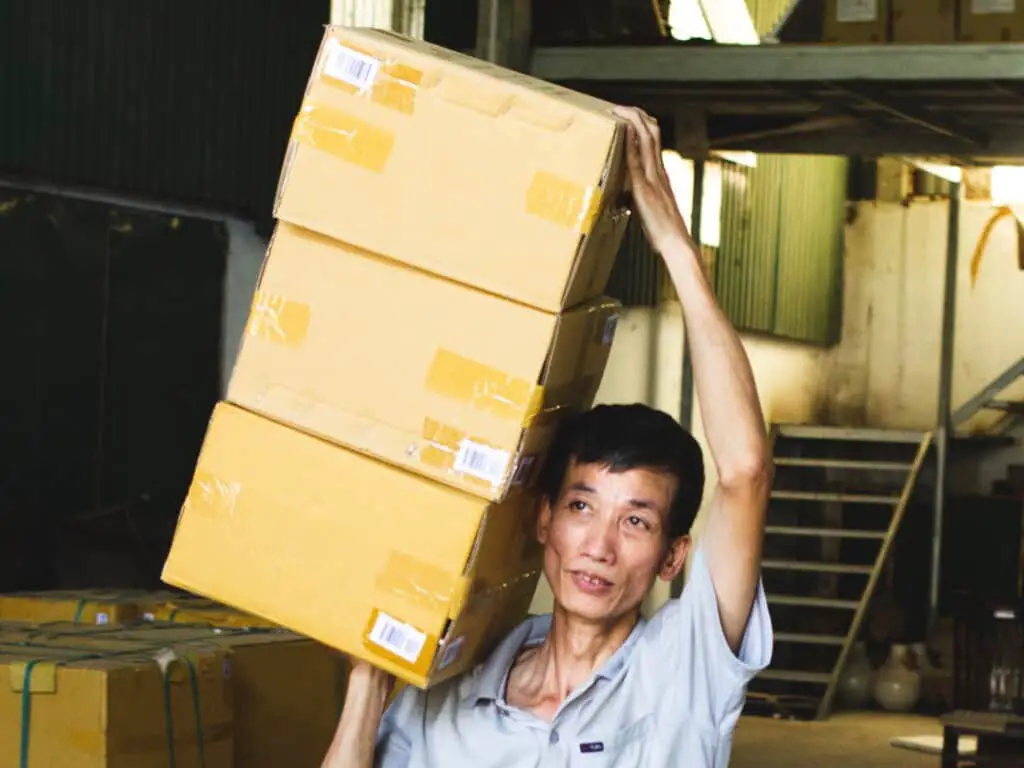
3. Packaging Engineering and the High Cost of the “Drop Test” and Sourcing Overseas
One of the most overlooked profit leaks in overseas home furnishings and décor manufacturing is under-engineered packaging. In B2B wholesale and direct-to-consumer (e-commerce) fulfillment, factory-standard packaging is rarely sufficient.
Standard Export Cartons vs. ISTA-Certified E-Commerce Packaging
Most Asian factories quote FOB prices based on standard bulk export packing: a 5-ply brown corrugated master carton with minimal internal EPS (polystyrene) corner blocks, designed exclusively to sit tightly packed inside an ocean container delivered to a local distribution dock.
If your distribution model includes parcel delivery (UPS, FedEx, DHL) or multi-touch 3PL cross-docking, standard packaging will fail.
Fragile home decor—such as oversized table lamps, mirrors, lacquerware trays, and delicate hand-woven furniture—requires:
- High-density honeycomb cardboard or molded pulp inserts.
- Reinforced edge protectors and 5-ply or 7-ply double-wall corrugated cartons with high burst-strength ratings (ECT-44 or ECT-55).
- Shrink-wrapping, desiccant packs for moisture control, and poly-bagging to prevent humidity blooms inside sealed shipping containers.
Upgrading from standard export packaging to rigorous ISTA-1A, ISTA-3A, or Amazon Ships-In-Own-Container (SIOC) packaging standards adds 3% to 8% to the unit’s base production cost.
Packaging Dimensional Weight and Ocean Freight Inefficiencies
Packaging is not just a material expense; it dictates shipping volume. If a factory over-packs an accent table with loose void-fill instead of engineered drop-in trays, the carton’s cubic meters (CBM) expand.
In maritime shipping, you pay for space. An unnecessary 15% increase in carton dimensions can reduce container capacity from 420 units to 350 units in a 40-foot High Cube (40HC) container. Suddenly, your freight cost per unit jumps significantly—all because packaging was treated as an afterthought.
4. Quality Control and Third-Party Pre-Shipment Inspections and Sourcing Overseas
Never rely solely on an internal factory QC report. While trusted manufacturing partners take immense pride in their craftsmanship, independent verification remains essential for commercial risk management.
When goods leave the port of origin, rectifying defects becomes exponentially more expensive. Reworking a batch of 800 finished table lamps at a domestic US warehouse costs tens of thousands of dollars in unpackaging, labor, rewiring, repackaging, and waste disposal. In contrast, catching a defect on the factory floor in Vietnam or China costs a fraction of that amount and keeps the financial responsibility squarely on the production line.
The True Cost of a Comprehensive QA Protocol
A rigorous Quality Assurance program includes:
- During Production Inspection (DUPRO): Conducted when roughly 15% to 30% of the order is completed to verify structural framing, raw wood moisture levels, and color matching.
- Final Random Inspection (FRI) / Pre-Shipment Inspection (PSI): Conducted when 100% of the goods are produced and at least 80% are packed into export cartons, following standard statistical sampling models (AQL 2.5 / 4.0).
- Container Loading Supervision (CLS): Verifying carton counts, checking container seal integrity, and ensuring cartons are handled correctly without structural crush damage during stuffing.
Engaging an accredited third-party inspection agency typically costs between $300 and $350 per man-day. For an order spanning multiple SKUs or multiple factories, budgeting 2 to 4 inspection man-days per shipment is standard.
Allocating $800 to $1,400 per container for quality assurance is not an optional overhead line item—it is an insurance policy. Factoring this into your unit landed cost prevents devastating product recall costs down the line.

5. Freight Volatility, Port Surcharges, and Drayage and Sourcing Overseas
Freight markets are volatile. While ocean container spot rates fluctuate based on geopolitical events, fuel prices, and macroeconomic shifts, many companies fail to account for the auxiliary surcharges that occur outside the ocean voyage itself.
| Logistics Component | Description | Cost Impact on Landed Goods |
| Ocean Base Rate | Port-to-port ocean linehaul shipping. | Can fluctuate dramatically depending on seasonal peak volume. |
| Bunker Adjustment Factor (BAF) | Fuel surcharges tied directly to global oil prices. | Added directly to ocean bills of lading; variable monthly. |
| Peak Season Surcharges (PSS) | Levied during high-demand quarters (Q3/Q4 holiday build-up). | Can add $500 to $2,000+ per container without warning. |
| Destination Port & Terminal Charges (DTHC) | Terminal handling fees charged by domestic ports upon arrival. | Typically $300 to $650 per container. |
| Customs Brokerage & Entry Fees | Documentation filing, ISF filing, and customs broker bond fees. | $150 to $350 per entry filing. |
| Inland Drayage & Chassis Rental | Trucking container from port terminal to distribution center/3PL. | $800 to $2,500+ depending on mileage, congestion, and chassis availability. |
| Demurrage & Detention Contingencies | Penalties for delayed container pickup or equipment return. | Can skyrocket to hundreds of dollars per day if port bottlenecks stall transit. |
If you fit 400 accent chairs into a 40HC container, and your total freight bill—all-in with drayage, fuel, terminal fees, and customs processing—totals $6,800, that adds $17.00 in freight per chair. If port congestion adds three days of detention fees or your drayage carrier implements a fuel surcharge, that number climbs higher.
6. Tariffs, Duties, and Trade Compliance (HTS Codes) and Sourcing Overseas
Customs duties can make or break product line profitability, particularly for brands sourcing across Asia.
The Classification Reality
Every imported item must be classified under a specific 10-digit Harmonized Tariff Schedule (HTS) code in the country of import. Duties are calculated as a percentage of the declared commercial invoice value (typically the FOB price).
- A wooden dining table may enter the United States under an HTS code carrying a standard duty rate of 0% to 3.4%.
- A metal side table or an upholstered armchair may carry a duty rate of 0% to 8%.
- Specialized lighting fixtures might trigger rates from 3.5% to 7.5%, plus additional testing compliance requirements.
Section 301 Tariffs and Trade Diversification
For US companies importing from China, the ongoing Section 301 punitive tariffs (often adding 7.5% to 25% on specific categories of furniture, ceramics, and home goods) altered the margin equation. This dynamic accelerated manufacturing diversification into Vietnam, where standard Most Favored Nation (MFN) duties apply without Section 301 tariffs.
However, moving production to Vietnam requires genuine local value-add and compliance with origin rules. Utilizing a transparent partner with established manufacturing networks in both China and Vietnam ensures your product development takes tariff classifications and regional supply chains into account from day one.
7. Regulatory Compliance, Testing, and Certifications and Sourcing Overseas
A product that looks magnificent in a showroom cannot be legally sold if it fails consumer product safety regulations. Testing is non-negotiable, and the fees fall on the importer of record.
Key Compliance Requirements in Home Furnishings & Lighting:
- UL/ETL Electrical Certifications (Lighting): Portable table lamps, pendant fixtures, and sconces sold in North America must meet UL 153 or UL 1598 standards. Component testing (sockets, wire harnesses, plugs) and laboratory file maintenance can cost from $1,500 to $4,500 per lighting family.
- Prop 65 & Heavy Metals Testing: California Proposition 65 requires testing for lead, cadmium, and phthalates in glazes, paints, and surface finishes for tabletop ceramics and decor. Lab screening costs roughly $200 to $500 per material/colorway.
- CARB II & TSCA Title VI (Wood Composite Products): Engineered woods, MDF, or plywood used in furniture carcasses must be certified for low formaldehyde emissions, requiring verifiable audit chains from the timber source.
- Lacey Act Declarations: Plant and timber products imported into the US require clear botanical genus, species, and harvest origin documentation to prove legal harvesting.
- Flammability Standards (TB 117-2013): Upholstered seating must comply with smolder resistance standards without utilizing restricted flame-retardant chemicals.
Neglecting these certifications risks container holds, customs seizure, severe fines, or forced product destruction. Spreading compliance laboratory testing fees over your total annual production volume is a fundamental step in arriving at true cost accuracy.

8. Working Capital, Cash Flow, and Financing Costs and Sourcing Overseas
Overseas manufacturing requires committing working capital for prolonged cycles. When you operate domestically, payment terms may be Net 30 or Net 60 after delivery. In international trade, the capital timeline looks very different.
The International Cash-to-Cash Cycle:
- Day 0: 30% deposit paid upon Purchase Order issuance to secure raw materials and reserve factory production capacity.
- Days 1–45: Raw material procurement, production line setup, assembly, finishing, and packaging.
- Day 50: QA inspection passed; 70% balance paid against the Bill of Lading (B/L) copy upon export clearance.
- Days 51–85: Ocean transit, port clearance, customs processing, and inland drayage.
- Days 86–110: Warehousing, cross-docking, and inventory distribution to wholesale accounts.
- Days 111–141: Wholesale receivables collection (Net 30 terms).
Your cash is tied up in raw materials, production, and transit for 90 to 140 days before generating a single dollar of returned revenue.
If your business relies on an asset-based lending facility, trade finance, or a line of credit with an annual percentage rate (APR) of 8% to 12%, financing that inventory during its 4-month transit and production window adds an invisible 2.5% to 4% carrying cost to your bottom-line unit expense. Managing inventory velocity and order cadences is vital to keeping financing overhead contained.
9. Real-World Case Study: The True Cost of an Accent Table and Sourcing Overseas
To demonstrate how these variables coalesce, consider this comparative model for an acacia and brass accent table manufactured in Southeast Asia, with an order run of 400 units (one 40HC container).
Project Baseline:
Order Volume: 400 units (1 x 40HC Container)
Factory Quoted FOB Price: $50.00
Expected Retail Price: $220.00
Target Wholesale Price: $110.00
The Cost Breakdown: FOB vs. Landed
| Expense Line Item | Total Cost for PO (400 Units) | Effective Cost Per Unit | % of Landed Cost |
| Factory FOB Production Price | $20,000.00 | $50.00 | 58.6% |
| Tooling & Custom Brass Extrusion Die | $1,800.00 | $4.50 | 5.3% |
| Prototyping, Master Samples & Express Airfreight | $1,200.00 | $3.00 | 3.5% |
| Upgraded ISTA-1A Drop-Test Packaging & Foam Mold | $1,400.00 | $3.50 | 4.1% |
| Pre-Shipment Inspection (PSI) – 2 Man-Days | $700.00 | $1.75 | 2.1% |
| Ocean Freight, BAF, PSS & Destination Terminal Fees | $5,200.00 | $13.00 | 15.2% |
| Domestic Drayage, Chassis & Port Unloading | $1,600.00 | $4.00 | 4.7% |
| Customs Clearance, Brokerage & Bond | $350.00 | $0.88 | 1.0% |
| Customs Import Duties (HTS Code 9403.60 @ 3.5%) | $700.00 | $1.75 | 2.1% |
| Safety Testing, Lacey Act Compliance & Documentation | $400.00 | $1.00 | 1.2% |
| Working Capital Financing Cost (90 Days @ 8% APR) | $760.00 | $1.90 | 2.2% |
| Total Real Landed Cost | $34,110.00 | $85.28 | 100.0% |
The Strategic Takeaway
The FOB price of $50.00 represented less than 60% of the true cost to put that table on the warehouse floor.
An inexperienced buyer who planned their retail pricing based on a naive assumption of “$50 FOB + $10 shipping = $60 landed” would have seen their anticipated profit margin slashed by more than $25.00 per unit. On an order of 400 tables, that represents a $10,112.00 unexpected hit to gross margin.
Planning with full visibility from day one allows you to price your products accurately, re-engineer packaging to lower freight volume, and protect your margins across every channel.
10. Partnering with Mondoro: Transparency in Overseas Manufacturing and Sourcing Overseas
Sourcing abroad does not have to be an unpredictable financial gamble. The world’s most successful home décor brands, luxury furniture lines, and hospitality design houses leverage overseas manufacturing precisely because the margins, custom craftsmanship, and scalability are unmatched—provided you manage the supply chain proactively.
This is why Mondoro operates differently.
We do not just hand you a factory quote and walk away. As a dedicated product development, design, and manufacturing partner with deep roots and operations across Vietnam and China, we help you navigate the entire journey:
- Design for Manufacturability (DFM): We review your technical packets, materials, and CAD files early, spotting production hurdles and eliminating unnecessary mold expenses before sampling starts.
- Packaging Optimization: We engineer protective packaging built for the realities of modern fulfillment, balancing drop-test protection with compact dimensional volume to keep ocean freight bills lean.
- On-the-Ground Quality Management: Our local teams oversee the production lifecycle directly on the factory floor—monitoring raw material kiln drying, moisture levels, hardware tolerances, assembly, and final packaging—ensuring your goods meet pre-approved golden master standards prior to container loading.
- Transparent Landed-Cost Planning: We help you map out your total project expenditure—from tooling amortization and testing certifications to logistics packaging footprints—giving you reliable cost metrics to protect your margins.
By pairing professional manufacturing oversight with transparent communication, we remove the guesswork from overseas production.
Ready to Build Your Next Home Décor or Furniture Collection?
Whether you are scaling an existing product catalog, diversifying production out of single-country dependencies, or launching an exclusive new collection from scratch, our team is ready to bring your designs to market with clarity, precision, and reliable margins.
Here is how we can start working together:
- Have a design ready? Submit your Tech Pack for a Comprehensive Feasibility & Cost Review. Our product engineering team will evaluate your specifications, material selections, and packaging requirements to provide transparent manufacturing guidance.
- Need proof of concept? Discuss a Custom Sample Request. Collaborate directly with our product development specialists to produce a production-ready golden master sample that captures your brand’s aesthetic standards.
- Looking for design inspiration? Download Our Latest Home Décor & Furniture Line Catalog. Explore our craftsmanship capabilities across sustainable natural weaves, mixed materials, hand-finished ceramics, and artisan-crafted accent furniture.
Contact Mondoro today to schedule an introductory consultation with our product development and sourcing directors. Let’s build your next collection on a foundation of craftsmanship, quality, and complete cost transparency.
Find out more about how Mondoro can help you create, develop, and manufacture excellent home decor and furniture products – don’t hesitate to contact me, Anita. Check out my email by clicking here or become a part of our community and join our newsletter by clicking here.
Mondoro gives out a FREE Lookbook to anyone interested. You can receive a copy of our latest Lookbook by clicking here.
Listen to our Podcast called Global Trade Gal and Deep Dive by Global Trade Gal. You can find it on all major podcast platforms. Try out listening to one of our podcasts by clicking here.
Subscribe to our Mondoro Company Limited YouTube Channel with great videos and information by clicking here.
Related Content
Pantone’s Color of the Year: Cloud Dancer – A Breath of Fresh Air for 2026
In true Pantone fashion, they surprised us all with a choice that goes beyond expectations: Cloud Dancer. This serene, versatile shade has captured my heart, and I believe it perfectly encapsulates the emotions, aspirations, and mindset of 2026.
Read our blog Pantone’s Color of the Year: Cloud Dancer – A Breath of Fresh Air for 2026 by clicking here.
Using Shapr3D and Google Gemini: A Powerful Design Duo
Read on as we will explore how I use Shapr3D, a cutting-edge CAD program, alongside Google Gemini, an AI-powered visualization tool, to enhance my design process. These tools are not just software—they’re design companions that help me bring my creative visions to life in ways that were previously unimaginable.
Read our blog Using Shapr3D and Google Gemini: A Powerful Design Duo by clicking here.
Why AI is the New Design Companion
Design is a deeply personal and creative process, driven by human imagination and ingenuity. At its core, design is about expressing ideas, solving problems, and creating something that resonates with others. But as the world evolves, so do the tools we use to bring our ideas to life. Enter artificial intelligence (AI), a technology that, when used correctly, can become one of the most valuable companions for designers, product developers, and creatives alike.
Read our blog Why AI is the New Design Companion by clicking here